Home
  • Home
  • About us
  • News
  • Projects
  • Contact Us
  • Publications
Home
 
 
Let's Not Forget the Children in Gaza
Tuesday, 26 January 2010

Children waiting in line for food Gaza 2009While the worlds’ attention is on the horrific disaster in Haiti with the Haitian government recently reporting over 100,000 dead and hundreds of thousands more injured, the Gaza Strip continues to spiral down a path of catastrophic deterioration.  The blockade on Gaza, now in its third year, brings more children to the brink of starvation each day with a record 1 in ten already suffering from severe malnourishment leading to stunting, a condition attributed to chronic lack of protein and micronutrients.  This is a manmade disaster with no end in sight, affecting an entire generation.


The economy is in collapse, unemployment continues to rise (41.5% officially as of the first Children in Gaza 2009quarter in 2009), and poverty desperately high at 80% with families living on less than one dollar a day per person.   The health sector, already volatile, is rapidly eroding affecting a society already on the brink.  In a report issued 20 January 2010, the World Health Organization stated “The closure of Gaza […] and the last Israeli military strike […] have led to on-going deterioration in the social, economic and environmental determinants of health.”  The report goes on to note that last year, “. . . 27 patients have died while awaiting referral . . .” to cross Eretz for medical treatment.


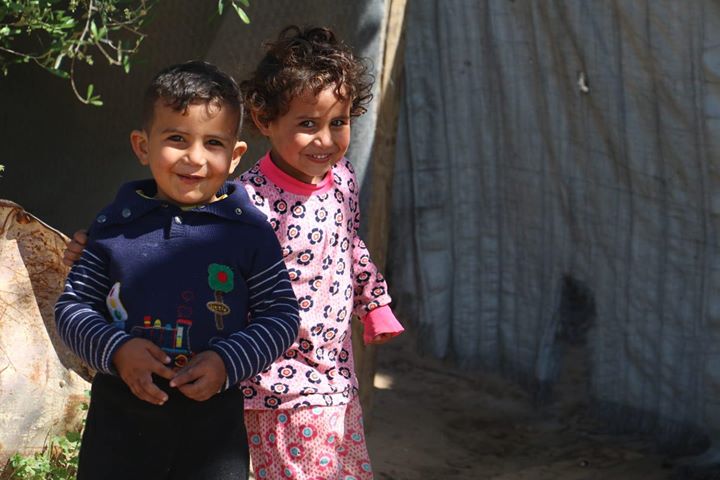
Children in Tent city Gaza 2009Prior to the blockade, 630 truckloads of goods including construction materials entered Gaza daily.  Today only 25% of that number trickles in with only 35 types of goods allowed, most of which are staple food imports. Just enough to drip feed a society though they are forced to remain in the freezing cold without structures, huddled in makeshift tents, under plastic sheets, or in the debris of their former homes as cement, lumber, and other building materials are not allowed.  As former President Jimmy Carter noted last year, ““I understand even paper and crayons are treated as "security hazards" and not permitted to enter Gaza.”


These are all the physical signs of a manmade tragedy.  Unseen amongst the children is trauma inBoy in demolished home knowing that there are no safe places in Gaza as their homes, schools, and play areas have been destroyed with no signs of repair.  The level of insecurity these children feel in incalculable and will affects every aspect of life for years to come.


Watching the images on television of the devastation that Haitian children are enduring, we find comfort in knowing that the world is pulling together bringing hope to their lives.  The children in Gaza seek the same hope.


Earthquake in Haiti
Thursday, 14 January 2010

A 7.0 earthquake struck the Haitian coast on 12 January rocking the capital affecting the cities of Port-au-Prince, Carrefour and Jacmel, all located in the West Province area which has an estimated population of 2.2 million.  The epicenter was located 22 kilometers from the capital, Port-au-Prince, a densely populated area.  A series of aftershocks have been felt and most people are in the streets, fearful of any standing structure.  

It is being reported that he number of deaths could be in the hundreds of thousands with many more injured.  Recent estimates indicate that at least three million people have been affected by the earthquake. In addition to the destruction of innumerable homes, many major structures have been reduced to rubble.  As the poorest country in the Western Hemisphere, Haiti is ill-equipped to respond to such a disaster.

“The devastation caused by the recent earthquake is beyond imagination. The survivors of this disaster desperately need our help and support, now and for the foreseeable future.  We must respond immediately and are directing all of donors to provide financial support to the following organizations,” Dr. Laila Al-Marayati

UNICEF:  www.unicef.org   and Partners in Health: http://www.standwithhaiti.org/haiti


Read more...
 
Gaza: One Year Later
Thursday, 24 December 2009

Two brothers waiting for foodPalestinians living under Israeli occupation continue to face a human dignity crisis, characterized by the erosion of livelihoods, the continued denial of basic human rights and a forced dependency on international aid that affects all aspects of their daily life.


The blockade, now in its third year, bans the movement of goods in and out of Gaza, as well as the people, many of whom are in need of medical treatment.  With the arrival of winter, families – most comprised of young children - who had their homes damaged or destroyed during the 27 December – 18 January military offensive must now endure the bitter cold either in tents or in their homes without windows, and in some instances living in makeshift tin shelters.  Over 20,000 people remain homeless.  Ordinary people bear the brunt of the blockade but primarily it is the children, 52.5% of the population and always the most vulnerable, whose fragile little bodies cannot endure the freezing temperatures.


In the whole of Gaza today, there are no sources of uncontaminated water leaving infants at risk of nitrate poisoning Mother feeding childand hundreds of thousands of people forced to buy  expensive water trucked in privately;  still others must rely on aid agencies to provide assistance.  Ninety per cent of the population experiences daily power cuts that are further exacerbated by the ban on generators across the border.  Ten per cent of the population has no power at all. .


John Ging, director of the United Nations Relief and Works Agency said recently, “We have run out of words to describe how bad it is here. [. . .] 750,000 children susceptible to an environment where things are moving rapidly in the wrong direction, where injustice is bewildering, and every day worse.”


Kinder USA is still working in Gaza doing what we can to care for the innocent children and their families.  Our projects continue, yet they are a drop in the sea of need. The legacy of the blockade and the destruction and loss of life will take generations to repair.  No child should have to endure this living hell.


Boys at home in tent cityFormer President Jimmy Carter said it best, “The cries of homeless and freezing people demand immediate relief. This is a time for bold action, [. . .], reconciliation and peace.”


We close another year humbled by the generosity of our donors who join us in working to bring change to the most vulnerable: the children. Under human rights law all people have the right to an adequate standard of living and the highest attainable standard of health.  Please consider a year end donation to help Kinder USA reach more children and offer the hope they need to sustain themselves through another year of hardship.


More...
  • Bringing shoes to the Children in Nahr al-Bared
  • Our Children in Gaza
  • An Update on our Children
<< Start < Prev 1 2 3 4 5 6 7 Next > End >>

Results 1 - 6 of 39

Main Menu

Home
About us
News
Projects
Links
Contact Us
Search
FAQs
Photo galleries
Publications


GuideStar Logo
GuideStar Logo

Latest News

  • Let's Not Forget the Children in Gaza
  • Earthquake in Haiti
  • Gaza: One Year Later
  • Bringing shoes to the Children in Nahr al-Bared
  • Our Children in Gaza

Help Us

We need your help and support to continue our mission for the children.

Newsletter Subscribe


© 2010 KinderUSA
Joomla! is Free Software released under the GNU/GPL License.