Skip to content
You are here: Home
The Besieged Children of Gaza


 The ongoing blockade of Gaza is causing severe humanitarian hardship and the situation is getting worse every day. The borders in Gaza have been closed for over two years now with only a trickle of food and humanitarian aid allowed to enter.  Just enough to keep children alive, but not living. 

The International Committee of the Red Cross (ICRC) in a recent report details that children are suffering from “deep psychological problems” since the recent Israeli military operations. Reconstruction efforts are at a halt due to the siege of Gaza that is entering its third year.  According to the ICRC, only 2,662 truckloads of goods entered Gaza from Israel in May of this year – a decrease of almost 80 per cent from the 11,392 truckloads allowed in during April 2007, just prior to the Hamas takeover of Gaza.

Over 70% of Gazans now live in poverty and malnutrition continues to increase among the most vulnerable - the children, with newborns entering the world anemic along with children under five and women of childbearing age. Children are being held hostage to the siege with one-fifth of school aged children reportedly iodine deficient while over 61% aged 9 - 12 months old suffer from anemia. The irreversible, long-term effects of such deficiencies include stunted growth, a diminished capacity to learn, and difficulty in fighting off infections.   

 Child labor is on the rise as children under the age of 15 are entering the workforce to assist heads of household in providing food for the family. 

Finally, with the school year about to begin in Gaza, 18 schools that were completely destroyed and the 280 others that were damaged over six months ago by the Israeli military have not been rebuilt or rehabilitated.  Again, this is because of the blockade and restrictions placed on the movement of reconstruction materials and other supplies into Gaza.  The Universal Declaration of Human Rights to the Convention on the Rights of the Child, access to education is an obligation of all governments. 

With the continuing closure, restrictions on imports make it virtually impossible for Gazans to rebuild their lives.

Former President Jimmy Carter during his recent trip to Gaza stated, “Tragically, the international community largely ignores the cries for help, while the citizens of Gaza are being treated more like animals than human beings.”

Kinder USA continues to do all within our power through your generosity.  As we prepare for our farmers program during the month of Ramadan, we will be contacting all of you to help in bringing food to the most vulnerable. 

The future of the children Gaza should not be reduced to a pile of rubble.  We must work together to rebuild not only the structures, but lives. The children in Palestine have the same rights as all children:  to grow in good health, peace and dignity. Thank you for your continued support and doing your part to make this possible.


TBC

The Blockade Continues. . .


Even before the most recent violence in Gaza, thousands of children were facing a humanitarian crisis, with little access to food, water, and health care.  As we pass the second year anniversary of the blockade on Gaza, today Gaza’s children continue to subsist on minimal nutrition, some live in tents, and for those who have structures still standing, they must live with holes in their walls, no windows, and no running water.

Due to the ongoing blockade, the amount of goods allowed into Gaza is one quarter of the pre- blockade flow. Eight out of every ten truckloads contains food but even that is restricted, affecting the lives of the entire population with children and the elderly being the most vulnerable.  The number food items actually permitted to enter Gaza is limited to 18, with prohibited goods such Halva, tea, and juice powder making the prohibition list. Seedlings and calves are not allowed and often clothes, shoes, toys and school books are prohibited.  Gazan’s are being kept on life support through the limited humanitarian aid allowed to enter.

Former President Jimmy Carter on his recent trip to Gaza stated, “Now, the aftermath of bombs, missiles, tanks, bulldozers and the continuing economic siege have brought death, destruction, pain, and suffering to the people here. Tragically, the international community largely ignores the cries for help, while the citizens of Gaza are being treated more like animals than human beings.” Further President Carter stated, “I understand even paper and crayons are treated as "security hazards" and not permitted to enter Gaza

On her recent trip to Gaza Dr. Laila Al-Marayati, Chairwoman of Kinder USA, spoke with many who felt they were “trapped” and as one mother put it, “The world looks at Gazan’s as if we are cockroaches with no human value at all”. 

Visiting one of the UNRWA funded schools Dr. Al-Marayati was met with students who were “bewildered and saddened” by the lack of support from the outside world which, in their mind, sat by while they were assaulted.  One of the students, Hatem, wanted the world to think of them as “human beings, normal teenagers who are just like them”.

“As we left Gaza, saying our goodbye’s, I felt as if we had just finished visiting people in jail, and while they were still trapped inside, we were free to leave”, said Dr. Al-Marayati.

Kinder USA continues its work in the region as we prepare for the month of Ramadan, working with local farmers to produce agriculture for distribution to families who will shop with vouchers for fresh produce, eggs, and cheese.  Please continue to support our important work as it is one way the children in Gaza will know we have not abandoned them.


One Child in Gaza

Only nine years old, Gaza-born Abdel Rahman has soulful brown eyes and a steady gaze.  His story is heart-breaking, but it is not unlike those of other Palestinian children living under extreme economic and psychological stress in Gaza.

Abdel Rahman was displaced from his family's home in the Izbet Abbed Rabbo area, north of Gaza City, as a result of the violence that began at the close of last year and continued into 2009.  Entire communities were devastated during the 22-day assault.  Abdel Rahman now lives with his parents and his five other siblings in one of the makeshift tent cities in Gaza, a legacy of the conflict that left long-established neighborhoods in ruins.

He is just one of the 56,000 children who are still homeless; innocent victims of the fighting. The lives of these children in the camps are extreme. They are displaced from familiar surroundings.  They have no access to clean drinking water, no toilets, no sewage disposal systems.  

One 9-Year-Old Child

Abdel Rahman is a case study about the suffering of Gaza's children.  After his family's home was destroyed during the conflict, he manifested signs of severe trauma and depression.  In his new "home" in a temporary camp in Gaza, Abdul Rahman refused to attend school.  He also would not play with friends, or participate in activities that non-governmental organizations (NGOs) coordinated. 

The trauma of the violence, and the abrupt dislocation of his family, left this young boy emotionally shattered, and arguably in a state of clinical depression.  The worst part of Abdul Rahman's story is that this 9-year-old refused to eat.  It was a critical situation.

Intervention

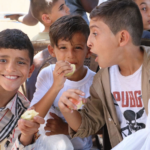
Kinder USA's bakery project in Gaza provided ready-to-eat pies - filled with meat, cheese, zatar, and vegetables - during and after the war in Gaza.  This project continues today with great need amongst the population.  Abdel Rahman's family is one of the beneficiaries of our initiative, funded by your generous donations.

Your contributions directly touched a 9-year-old boy in Gaza whose life was profoundly traumatized and dislocated during unrelenting violence that has left scars that can be treated, but rarely healed.  Under international humanitarian law, innocent children such as Abdel Rahman are entitled to protection in such conflicts yet he, and countless other children in Gaza, were not spared.

One Child At a Time

Kinder USA staff members in the field monitored Abdel Rahman closely.  At first, when food was delivered, he was unresponsive, and did not greet our staff members who arrived to deliver food to his family.   Our staff members were not discouraged.

With every delivery of fresh-baked pies, they sought out this reluctant 9-year-old boy, and tried to engage him in conversation.  Abdel Raham finally opened up. His words poured out.  He was frightened. He reflected on the suffering that he and his family endured during the conflict and told Kinder USA representatives that he did not want to spend the rest of his life with his family in an internally displaced tent camp.  Citing his family's poverty, he voiced his own fear that they would never be able to build another house to replace their home that was demolished during the conflict. And at 9 years old, Abdel Rahman was cynical about the prospects of international support to help his parents rebuild the family's former home in Gaza.

Even if this happened, and the house was rebuilt, he asked this important question: "Who will stop our home from being demolished again?"

The positive part of this story is that Abel Rahman started to eat again, an indicator that he was successfully moving beyond the ongoing psychological and emotional stress of dealing with his family's experience of living through violence and homelessness.  In his tent camp, he finally began to wait for, and welcome, Kinder USA representatives who arrived with fresh baked pies.  He looks forward to talking with them, and now with a hearty appetite eats the food that your donations provide.

Your Continued Support

During a recent winter storm, camp residents were advised to seek shelter elsewhere because the families' tents were being blown away by strong winds and rain.  Abdel Rahman, speaking for his family, said that they would not leave the tent city. Smiling, he said that he was waiting for the next arrival of food from Kinder USA.

With your help, this thoughtful, reflective 9-year-old from Gaza will survive, and thrive.

Please continue to support this project by making an online tax-deductible donation today choosing 'Gaza ER' from the drop down menu in the donation folder.  Reversing the pain these innocent children have endured is everyone's responsibility.  Thank you.


<< Start < Prev 1 2 3 4 5 6 7 8 9 10 Next > End >>

Page 5 of 15

Newsletter Subscribe

Name:

E-mail:

Donations